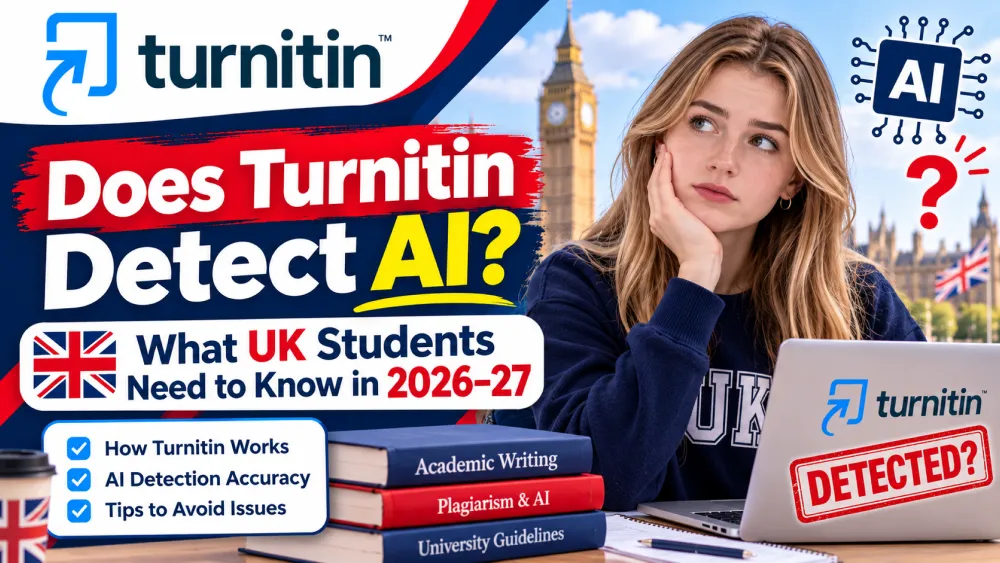
Artificial intelligence has changed how students research, plan, and prepare university assignments. However, its growing use has raised an important question: does Turnitin detect AI-generated writing?
The short answer is yes: Turnitin offers AI writing detection, but its results are not definitive proof that a student has used artificial intelligence improperly. The technology estimates whether qualifying text may have been generated using AI, and its findings require careful interpretation.
For UK students entering the 2026–27 academic year, understanding how this technology works is important for maintaining academic integrity, protecting their work, and following university assessment rules.
This guide explains Turnitin’s AI detection capabilities, the meaning of its reports, the possibility of false positives, and what students should know about university policies and data privacy.
Does Turnitin Detect AI in 2026–27?
Yes, Turnitin offers an AI writing detection feature designed to help educators identify text that may have been generated using artificial intelligence tools.
According to its official documentation, the system analyses qualifying prose and estimates what proportion may have originated from an AI language model. Its English-language detection capabilities also cover AI-generated text that has been modified with AI paraphrasing or bypassing tools.
Turnitin announced an update to its English AI writing detection model on 14 October 2026, aiming to improve detection while minimising false positives. Existing reports are not automatically updated following this release; previously submitted work must be resubmitted to generate a report using the updated model.
However, three important points should be understood:
- AI detection is different from conventional similarity checking.
- An AI writing score is an indicator, not conclusive evidence of misconduct.
- Whether AI use is permitted depends on the relevant university and assessment rules.
Therefore, interpret a Turnitin report in context rather than treating it as an automatic judgement of a student’s work.
How Does Turnitin AI Detection Work?
Turnitin uses an AI writing detection model to analyse eligible text and estimate whether it resembles generative AI-produced writing.
The system processes eligible submissions and generates an AI Writing Report when the relevant feature is available and enabled.
Its report can include an overall percentage and highlighted passages that the model identifies as potentially AI-generated. For supported English-language submissions, the reporting system can also distinguish between likely AI-generated text and text identified as AI-generated and subsequently modified using certain AI tools.
Turnitin does not simply compare an essay against a database of AI-generated answers. AI detection and similarity checking perform different functions.
The distinction matters because an essay can use original wording while still raising questions about how it was produced. Equally, matching text does not automatically mean that AI was involved.
Turnitin AI Detection vs Similarity Checking
| Feature | AI Writing Detection | Similarity Checking |
|---|---|---|
| Main purpose | Estimates whether qualifying text may be AI-generated | Identifies text matching sources in its comparison database |
| Report output | AI writing score and relevant highlights | Similarity score and matching passages |
| What it establishes | An indication that warrants interpretation | The extent of text matching, not necessarily plagiarism |
| Main limitation | Can produce incorrect classifications | Matches require contextual assessment |
What Does a Turnitin AI Score Mean?
A Turnitin AI score indicates the proportion of qualifying text that its detection model identifies as likely AI-generated, including certain text that may have been subsequently modified using AI tools.
It should not automatically be interpreted as the percentage of an assignment that was dishonestly written.
For example, an AI writing score does not establish a student’s intentions, explain how a particular passage was produced, or independently determine whether the university’s rules were broken.
Turnitin’s current reporting guidance also treats scores below its 20% reporting threshold differently because of the risk of false positives. Under the current system, reports may show an asterisk instead of a precise percentage when the detected amount falls within this range.
Students should therefore avoid concluding a number alone. The report must be considered alongside the assignment, the institution’s policy, and the available evidence.
Can Turnitin Detect ChatGPT and Other AI Tools?
Turnitin’s AI writing detection is designed to identify text that may have been generated using large language models, including AI writing tools such as ChatGPT.
Its detection capabilities depend on the supported language, the type and length of the submitted text, and the current model’s capabilities.
According to Turnitin’s documentation, an AI Writing Report generally requires at least 300 words of qualifying prose in a supported language. The documented maximum is 30,000 words, with additional file-size and file-format requirements.
However, detection is not guaranteed. The technology can misclassify both human-written and AI-generated material.
Students should not assume that every AI-generated passage will be identified or that every passage flagged by a detector was produced by AI. The responsible approach is to follow the assessment rules and ensure that submitted work accurately represents their own contribution.
Can Turnitin Mistakenly Flag Human-Written Work?
Yes, AI writing detection can produce false positives. A false positive occurs when a system incorrectly identifies human-written material as likely AI-generated. Turnitin explicitly acknowledges this limitation and advises against using its AI writing score as the sole basis for adverse action against a student.
An unexpected score should therefore be interpreted carefully rather than treated as conclusive evidence. If you believe your work has been incorrectly flagged, consider the following steps:
- Review the report: Examine the passages identified and understand what the report actually indicates.
- Preserve your working materials: Keep relevant notes, research records, outlines, drafts, and version history that demonstrate how you developed your work.
- Check your university’s policy: Establish which AI uses were permitted for the particular assessment.
- Ask for clarification: Contact your tutor or academic adviser if you are uncertain about the report or the applicable rules.
- Follow the formal procedure: If an academic integrity concern is raised, respond honestly and use the institution’s established process.
The University of Bristol similarly explains that an AI score should be treated as an indicator rather than proof and considered alongside academic judgement and the wider context of the assessment.
What Are UK Universities’ AI Policies for 2026–27?
No single rule governs AI use across all UK universities and assessments. Some assessments prohibit generative AI entirely, while others permit specified forms of assistance, such as brainstorming, preliminary research, or language review. Some require students to acknowledge their use of AI tools.
For example, University College London’s guidance for its Centre for Languages and International Education distinguishes between assessment categories and explains when AI assistance is permitted. It also emphasises that AI must not replace the student’s own substantive contribution if doing so would violate the assessment requirements.
Before submitting an assignment, students should check:
- Whether AI tools are permitted for that particular assessment.
- Which activities are allowed, such as planning, proofreading, or research support.
- Whether AI use must be declared or referenced.
- Whether the course provides specific instructions about acceptable assistance.
- What procedure applies if the institution raises an academic integrity concern.
If the instructions are unclear, ask the module leader or tutor before relying on an AI tool.
Turnitin, Student Privacy, and the 2026–27 Academic Year
Student data and intellectual property have also become important topics in discussions about Turnitin.
In October 2026, Royal Holloway reported that Turnitin had paused proposed changes to its end-user licence arrangements until at least September 2027 following concerns raised by UK universities. The university also reported Turnitin’s reassurance that submitted student work was not being used to train generative AI models and that there were no plans to do so.
Queen Mary University of London’s October 2026 update similarly stated that the proposed licence changes would not be introduced during the 2026–27 academic year, with subsequent changes remaining under consideration.
These developments illustrate why students should consult current university communications rather than relying on outdated claims about data handling.
If you have concerns about how your assignment is processed or stored, consult your institution’s guidance and the relevant privacy information. Read our blog if you failed your dissertation.
How Can Students Maintain Academic Integrity When Using AI?
The safest approach is to understand the rules before using AI and ensure that your submitted assignment reflects your own learning and contribution.
Use AI only for permitted purposes. If your university allows planning or research assistance, stay within the specified boundaries.
Evaluate information independently. Check claims against credible academic sources rather than assuming that AI-generated information is accurate.
Develop your own arguments. Your analysis should demonstrate your understanding of the topic, engage with appropriate evidence, and meet the assignment requirements.
Keep appropriate records. Retaining notes, drafts, and research materials can help you explain your writing process if questions arise.
Acknowledge AI assistance when required. Follow your institution’s rules on disclosure, citation, and declarations.
For additional guidance on academic writing and assignment expectations, students can consult the resources available through UK Assignment Writing.
Final Thoughts
So, does Turnitin detect AI? Yes, it provides AI writing detection designed to help educators identify text that may have been generated using artificial intelligence.
However, its results are estimates, not definitive proof of academic misconduct. The October 2026 model update demonstrates that detection technology continues to evolve, while Turnitin’s own guidance recognises the possibility of false positives.
For UK students in 2026–27, the most important priorities are understanding assessment-specific AI rules, producing work that reflects their own learning, acknowledging permitted AI assistance, and keeping appropriate records of their research and writing process.
By approaching AI tools responsibly and understanding the limitations of detection technology, students can make informed decisions and protect the integrity of their academic work.
FAQs
1. Does Turnitin detect AI in 2026–27?
Yes, Turnitin offers AI writing detection, and its official documentation records an update to its English detection model in October 2026. However, its results are not definitive proof that AI was used improperly.
2. Can Turnitin detect ChatGPT?
Turnitin is designed to identify qualifying text that may have been generated by large language models, including ChatGPT. Detection is not guaranteed, and the results require careful interpretation.
3. Is a high Turnitin AI score proof of cheating?
No, Turnitin states that its AI writing score should not be used as the sole basis for adverse action against a student. Institutions must consider the wider context and apply their own academic policies.
4. Can Turnitin flag human-written text as AI?
Yes, AI detection systems can produce false positives. Turnitin acknowledges this possibility, so an AI score should be considered alongside other relevant information.
5. Is Turnitin’s AI score the same as its similarity score?
No, the AI writing score estimates how much qualifying text may be AI-generated, while the similarity score identifies matching text in comparison sources. They measure different things.
6. Do all UK universities prohibit AI use?
No, policies vary by institution, course, and assessment. Some uses are permitted in certain circumstances, while others are restricted or prohibited. Students should follow the specific instructions for each assessment.
7. What should I do if Turnitin flags my assignment?
Review the report, consult your institution’s AI policy, and preserve relevant drafts and research records. If a concern is raised, respond honestly and follow the university’s established academic integrity procedure.
8. Does Turnitin use student assignments to train AI models?
Turnitin stated, as reported in October 2026 by UK universities, that it did not use submitted student work to train generative AI models and had no plans to do so. Students should consult current official privacy information for the latest position.
9. Has Turnitin’s AI detection changed for 2026–27?
Turnitin’s official release notes document an English AI detection update dated 14 October 2026. The company stated that the update aimed to improve detection while minimising false positives.
10. Can students appeal an AI detection concern?
Students should consult their institution’s academic integrity policy to understand the applicable review, response, or appeal process. They should preserve relevant evidence of their work and follow the university’s official procedures.
Reference: https://www.educationalpolicy.admin.cam.ac.uk/plagiarism-and-academic-misconduct/turnitin